Elastos now has a unified documentation portal at docs.elastos.net, designed to make the ecosystem more accessible to developers, node operators, stakers, and general users.
For a long time, information across the Elastos ecosystem has been distributed across GitHub repositories, legacy documentation, archived resources, and separate websites. While the technology itself has continued to develop, the supporting documentation has not always provided a clear or consistent starting point for those trying to understand or build on Elastos.
The new portal is intended to address that directly.
A single documentation home for the Elastos stack
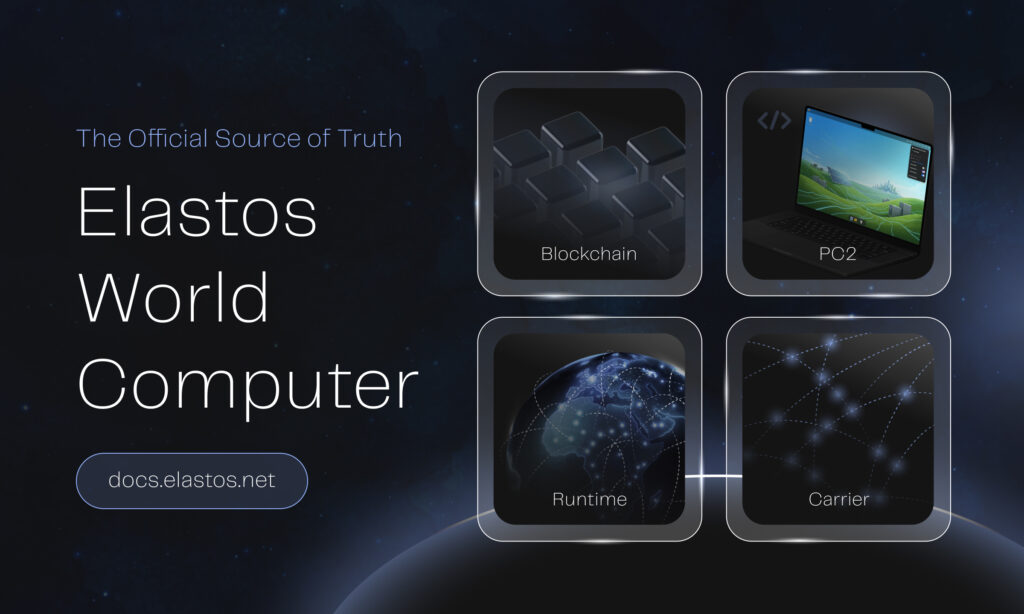
Elastos is broader than a single blockchain. It includes the blockchain layers, a personal cloud environment, an execution runtime, and a peer to peer networking layer. The portal is structured around these four core pillars:
- Blockchain: Documentation for the ELA main chain, ESC, EID, staking, cross chain activity, and DAO governance.
- PC2: Documentation for the Personal Cloud Computer, including wallet based access, storage, local AI, and related user infrastructure.
- Runtime: Documentation for the execution layer, including application permissions, sandboxing, and the SmartWeb security model.
- Carrier: Documentation for the networking layer, including peer discovery, NAT traversal, encrypted connections, and the Boson Network.
This structure gives users a clearer way to navigate the ecosystem without needing prior knowledge of how the different components are separated across repositories or technical domains.
Built for users, builders, and operators
The portal is organized into three practical sections:
- Use: Guides for those interacting with Elastos without writing code, including wallet setup, staking, governance participation, node setup, and PC2 installation.
- Build: Guides for developers working with smart contracts, DIDs, wallets, storage, and peer to peer systems.
- Reference: Technical material including protocol details, architecture explanations, repository status, operational references, and deprecation history.
This makes the portal usable for very different audiences while keeping the content organized by purpose.
Search and AI-assisted documentation access
The portal includes both full text search and an AI assistant.
Search makes it easier to locate the right page directly. The AI assistant is designed to answer questions using the content of the documentation itself, helping users understand specific concepts and workflows more easily.
This supports questions such as:
- How do I set up a node?
- What is the difference between ESC and EID?
- How does ELA staking work?
Repository inventory and status visibility
One of the most important parts of the portal is the repository inventory.
It provides a structured view of public repositories across the Elastos and CyberRepublic GitHub organizations, including status indicators such as active, maintained, stale, archived, forked, or deprecated.
This is important for developers and contributors because it reduces the risk of relying on outdated or replaced components and gives a clearer picture of what is current across the ecosystem.
Built as a long term documentation system
The portal is not intended as a one time publication. It is built on modern tooling, searchable, version controlled, and structured for long term maintenance. It also includes llms.txt, allowing AI tools and LLM based systems to interpret the documentation more effectively.
The result is a more coherent and maintainable documentation foundation for the Elastos ecosystem.
For developers evaluating the stack, operators running infrastructure, community members participating in governance, or users who simply want a clearer understanding of Elastos, the new portal is now the primary place to begin: docs.elastos.net