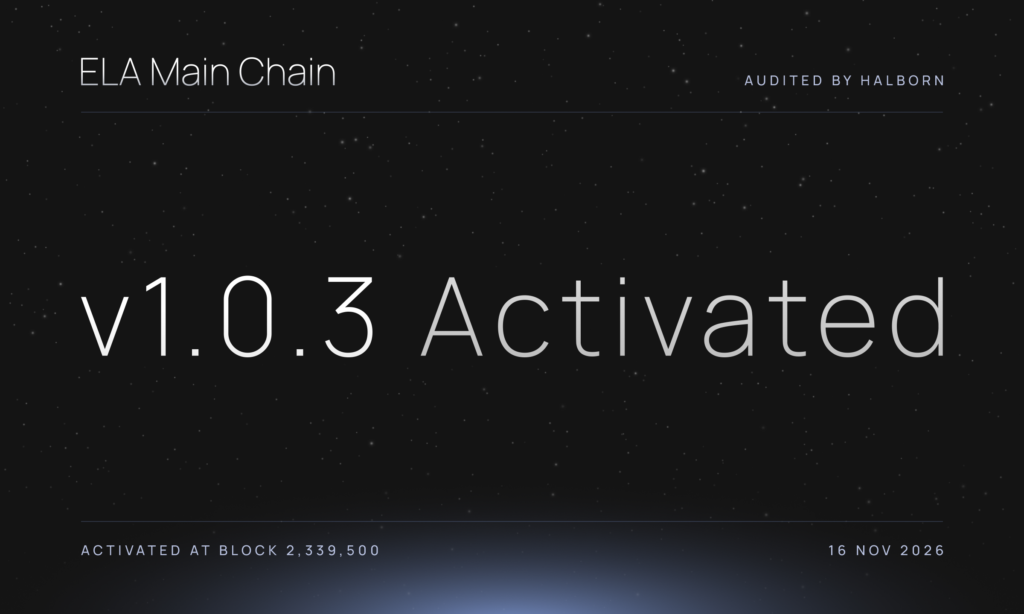
The release completes the work set out in the August postmortem, including an independent security audit, a wider review of the main chain code and the return of the frozen reserve funds. It contains more than 100 changes since v1.0.2. Halborn audited the main chain node and reviewed the fixes before activation.
Reserve recovery
The recovered ELA had been frozen on the main chain since the 13 July cross-chain reserve incident. The v1.0.3 rules specified the recovery transfer, and the network accepted it in the activation block. Anyone can verify the transfer on the main chain using the transaction ID below.
Recovery transaction ID
9ede769094b92ffb58af445b1d53feaa202317480fa8fdc74961a0a04c039052
Activation block hash
72731b5edafe34cbcefa506b048f62d1e918f1e4eb44a7271e128e25ef62a994
How this builds on the August recovery
The August release fixed the flaw behind the separate 20 July main chain incident. Elacity Labs then focused its internal review on how the node calculates transaction values and accounts for the ELA supply, the Council treasury and the bridge reserve.
Halborn examined the full node, including how it behaves under heavy load or when peers send invalid data. Most of its findings concerned the network’s ability to keep nodes online, produce blocks and stay in sync. August main chain postmortem
Independent audit by Halborn
Halborn assessed the ELA main chain node from 28 August to 9 October 2026. Its team reviewed the code manually, ran custom tests against the production code, and used fuzz testing and static analysis. Halborn then reviewed the fixes.
Of the 48 findings, 32 concerned network availability, including all six critical findings, both high findings and all three medium findings. Halborn rated the five findings that concerned funds as low or informational. None concerned the creation of ELA.
The team resolved 34 findings in full, including all six critical findings. One high finding is resolved for all synced nodes; a narrow case that affects only a new node during its first sync from block zero remains, and is avoided by starting from the published snapshot. The team accepted the risk on three low findings and acknowledged ten informational findings. None of these remaining items puts funds or block production at risk.
| Severity | Findings | Outcome |
|---|---|---|
| Critical | 6 | 6 resolved |
| High | 2 | 1 resolved, 1 partially resolved |
| Medium | 3 | 3 resolved |
| Low | 10 | 7 resolved, 3 risks accepted |
| Informational | 27 | 17 resolved, 10 acknowledged |
Internal review and testing
Elacity Labs began its own review before the Halborn assessment and continued it during the audit. That work identified further issues, including how the node accounts for Council funds when a proposal ends or a new Council takes office. The team had already corrected many of these issues in the code it sent to Halborn.
Before release, the team tested every fix against the full history of the chain, on multi-server test networks that mirror mainnet, and under sustained adversarial testing.
What v1.0.3 fixes
The list below covers the fixes in the release, from both the internal review and the Halborn assessment, in plain words. Halborn’s full report is attached to this article for readers who want the technical detail.
The reserve
- The 1,585,252 ELA frozen since 13 July went back to the ESC bridge reserve. It happened once, in the activation block, and cannot happen again.
- The address that held those coins stays frozen. It can neither send nor receive ELA.
- The freeze is built into every mainnet node. No operator can switch it off in local settings.
- Before activation, each node checked by itself that the recovery could go through exactly as written.
- Nobody can copy the recovery or send it again as an ordinary transaction.
Council treasury and proposals
- When a proposal ends or the Council terminates it, money advanced to it but not spent stays in the community treasury. It can no longer be claimed.
- When a new Council takes office, the node counts the treasury again from the real records, so the budget it starts with is correct.
- The sums for releasing a Council deposit and for penalties can no longer fall below zero or exceed what exists.
- A Council member who breaks the rules is charged once, not again with every new block.
- Every node now decides in the same way who is a sitting Council member at a handover.
- Transactions that move Council funds face stricter checks.
- The result of a proposal is placed first when a block is built, so everything after it in the block sees the right result.
- New blocks are built by the same rules that are used to check them, so a block maker cannot produce a block the network refuses.
- Updating a Council member’s profile can no longer wipe that member’s identity record.
- A Council member’s claim to run a node must match that member’s deposit.
- A bad treasury transaction can no longer push good ones out of the waiting queue.
Signers and block production
- The handover from one group of signers to the next is checked. A false message about who signs next is refused.
- The node works out correctly whose turn it is to sign.
- Each signer’s approval counts once. A block cannot carry more approvals than there are signers.
- A notice that says signers are inactive is checked before any node acts on it.
- Blocks with forged content are refused, including a block with no parent and a block that claims an impossible height.
- A node keeps the block the signers approved until the approval step is finished.
- The block maker reads one consistent picture of the chain while it builds a block.
- A block’s time stamp and the work it asks of a node are limited.
- The amount of signature checking one block can demand is capped.
- Vote weight is calculated the same way on every type of machine.
- A signer with a broken key or a broken network address can no longer knock other signers offline.
- Votes and proposals a node has already checked are not checked again, which saves time under load.
Producers, staking and rewards
- Each producer is counted once, from its current record.
- A request to activate a producer cannot use the same coin twice.
- The rules for registering, updating and activating a producer are stricter.
- Evidence that a signer misbehaved is checked more strictly before it leads to a penalty.
- Rewards are paid in batches and in a fixed order, so every node pays the same people the same amounts.
- If the chain switches to another branch, reward payouts are undone and redone correctly.
- Renewing two equal votes in one transaction no longer loses one of them.
- A vote exchange can only credit the stake of the person who signed it.
- The check on returned votes has a limit on the work it can cost.
- The node wallet never creates an empty output when it claims rewards.
Blocks and transactions
- Badly formed data is refused. It can no longer stop a node.
- Counts and sizes read from incoming data are capped before the node acts on them.
- Each block and transaction is fully checked before a node stores it, passes it on or acts on it.
- A transaction with a 0 ELA output is refused.
- The waiting queue for transactions has a size limit, and it refuses transactions that no block could hold.
- The waiting queue remembers signatures it has already checked, so it does the work once.
- The store of incoming blocks has a size limit and keeps only blocks that carry real mining work.
- A bad block that arrives early can no longer delay the honest block beside it.
- The proofs that tie a transaction to its block are checked correctly.
- A key is verified before it is used to sign, and a short encrypted message can no longer stop the node that receives it.
Network and peers
- The first greeting between two nodes is checked more strictly. One peer can no longer take many connection slots by reusing one identity.
- Every network message is checked for size and content.
- There are firm limits on how many peers a node accepts and on the memory and work any one peer can use.
- Messages waiting to go to a slow peer can no longer pile up without limit.
- A peer that lies about its height can no longer hold up synchronisation.
- Honest peers are no longer dropped for saying they do not have a block, or for sending a normal batch of announcements.
- A node that gets stuck while synchronising frees itself.
- Requests that used to freeze or break a connection are now handled safely.
- A node takes the time only from peers it knows.
- There is one rule for the addresses a node will call, and signed addresses are accepted only from known signers.
- The store of side chain blocks is now limited in size.
- Several timing faults in connection handling are closed.
Cross-chain transfers
- A refund must name a real deposit.
- A badly formed refund is refused and can no longer stop a node.
- Evidence from a side chain is checked before a node passes it on.
- Cross-chain instructions that are too short to be valid are refused.
- Transactions that move ELA between the main chain and the side chains face stricter key checks.
Restarts, recovery and data safety
- A node survives a save that was interrupted halfway.
- A node rebuilds unusable save files by itself.
- A node never replaces a good save with an older one from the same height.
- Block data is written to disk before a new save is accepted.
- After a restart, a node returns to the correct branch of the chain.
- When the chain switches branch, every record is restored exactly, including the Council and signer records.
- A branch switch that fails partway is handled safely, and a rollback can repeat its last step.
- Parts of the node that share chain records now take turns properly, so one cannot read a record while another is changing it.
Operators and tools
- A pre-flight check tells an operator before start whether the node is ready.
- Operator messages are clearer and name the right remedy.
- A node with an unusable settings file starts with a warning and safe defaults.
- The query interface limits the work it accepts, and its “synced” check answers at once.
- The signature status check refuses badly formed requests.
- The node wallet refuses unsafe multi-signature and vote requests, and can no longer create an address that nobody could spend from.
- Settings that must be the same on every mainnet node are built in and cannot be changed locally.
Source code and audit report
Check Halborn’s full report here: Managed Penetration Test · Halborn ONE
The full source code remains private while the team completes a small number of remaining items, and the team will publish it with a later release.
Node operators
If your main chain node still runs an earlier version, upgrade to v1.0.3 now. Block 2,339,499 was the last block older versions could follow. The upgrade keeps your existing chain data and requires no resync. Upgrade instructions and checksums