This week focused on post-release hardening after the ElastOS v1.2 release.
After v1.2 shipped, the team moved through a fast point-release cycle from v1.2.1 to v1.2.7.13, covering installer fixes, launcher status, wallet signing, ESC transaction handling, IPFS fetching, media playback, Mac transport setup, dApp Centre polish, and Runtime Home progress.
The main goal was simple: fix real issues from fresh installs, updates, and early v1.2 usage.
What shipped this week
- Fresh install bug fixes across PC2
- Launcher heartbeat support for better node status tracking
- WalletConnect signing fixes
- ESC transaction handling for Glide swaps
- IPFS upload, fetch, and download progress fixes
- Media playback improvements with parallel segment prefetching
- Mac transport setup for WireGuard, AmneziaWG, and VLESS Reality
- dApp Centre, Start Menu, and Market UI cleanup
- Runtime 0.2.0 and Home progress
- dDRM metadata alignment across Creator, Market, backend, and PC2
- Elacity on the Road: Ecosystem and BD
1. ElastOS v1.2 point-release cycle
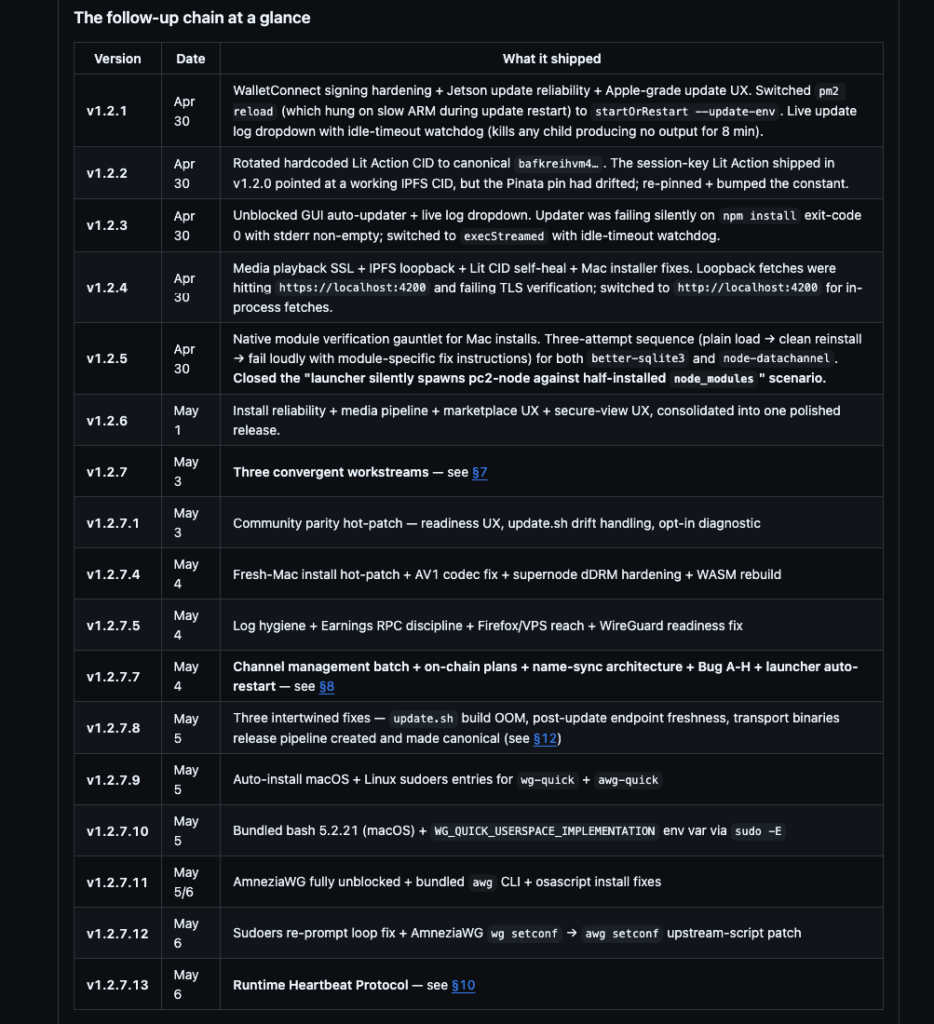
The team shipped a series of point releases after v1.2, moving from v1.2.1 through v1.2.7.13.
These releases focused on issues found during fresh installs, updates, and live usage across different environments, including Mac, Jetson, VPS nodes, wallet sessions, media playback, and local IPFS paths.
2. Fresh install fixes
Fresh install work continued this week.
The team cleaned up native database dependency handling by moving away from paths that could require local compiler tooling and toward packages with platform prebuilt binaries.
MacOS setup also improved. WireGuard, AmneziaWG, and VLESS Reality were tested on a clean MacBook setup path without Homebrew, Xcode command-line tools, or manual sudoers changes.
3. Launcher heartbeat and node status
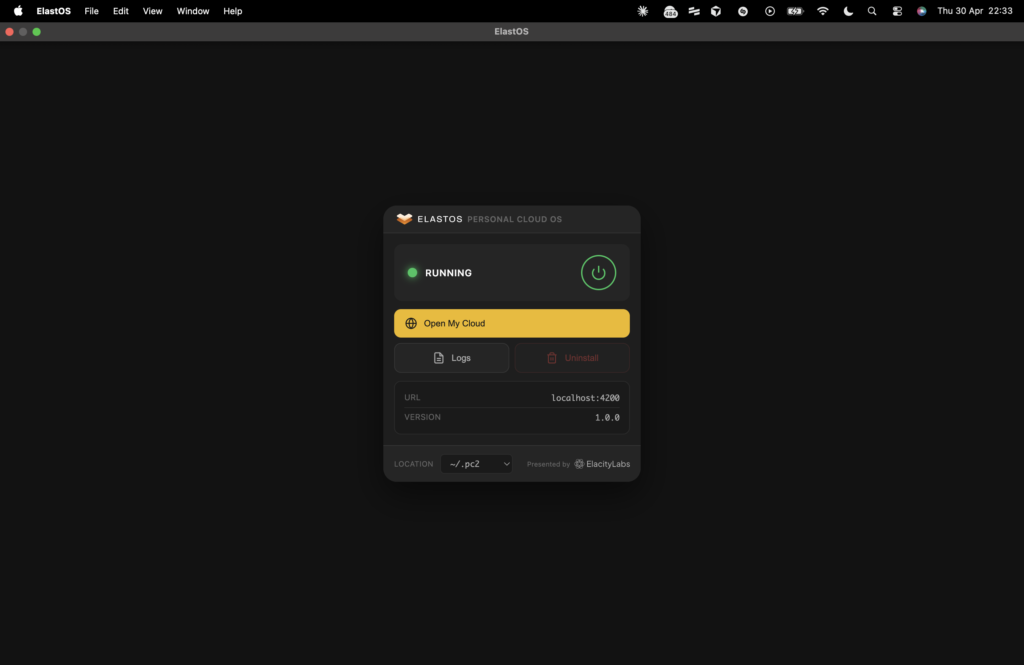
The launcher now has a heartbeat protocol with pc2-node.
This allows the launcher to track node status more reliably through restarts, updates, and service state changes.
The goal is to make launcher state clearer when PC2 is running, updating, restarting, offline, or waiting on the node.
4. WalletConnect and ESC transaction fixes
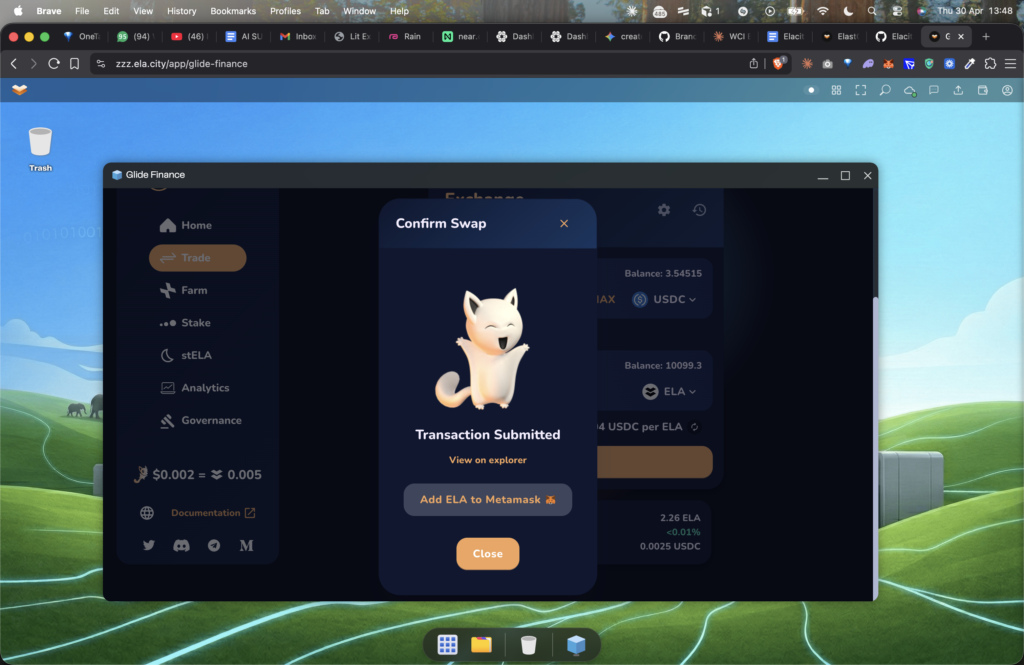
Glide usage on ESC exposed a transaction formatting issue.
Some wallet flows attempted EIP-1559 style transactions where ESC expected legacy transaction formatting, causing the rlp: expected input list for types.txdata error.
The wallet bridge now forces legacy type-0 transactions for ESC.
RPC fallback handling was also improved, including provider priority, cached reads, and better handling of providers that return rate-limit errors inside JSON responses.
5. IPFS and capsule fetching
The IPFS path received several fixes.
Creator uploads now store files locally first, return the CID, then replicate to the public Elacity IPFS node in the background.
The buy flow now waits until .ddrm capsules are fully fetched and verified before opening playback.
Download progress now uses real byte counts across the DAG. A reset download button was also added to recover from stuck downloads and failed pin attempts.
6. Media playback improvements
Media playback received parallel segment prefetching.
The player can now fetch several segments ahead instead of waiting for each segment one by one. This improves playback behavior when network conditions are uneven.
This work builds on the v1.2 media path and focuses on the playback flow after content is fetched, verified, and opened through PC2.
7. dApp Centre and Start Menu cleanup
The dApp Centre and Start Menu received more polish after v1.2.
Updates included:
- Proper branded icons for Elastos DAO, Elacity Creator, AI Chat, Player, Viewer, and the dApp Centre
- Dark mode support for the Elastos DAO dashboard and dApp Centre cards
- Start Menu ordering improvements
- “Free” badges on relevant Market cards
- System apps protected from normal uninstall flows
- Creator draft recovery fixes for saved Lit and IPFS steps
8. Transport setup and native binaries
Transport setup also moved forward.
WireGuard, AmneziaWG, and VLESS Reality were tested through a clean Mac setup path.
Native transport binaries now have their own release pipeline, making it easier to maintain transport support across machines and future PC2 releases.
9. Runtime 0.2.0 and Home
Elastos Runtime continued moving forward this week.
Runtime 0.2.0 work focused on Home, the new front door for the Runtime path.
Home is being built around apps, windows, launcher, taskbar, inbox, mobile and PWA support, wallpaper settings, and capsule navigation.
Passkey-first authentication also moved forward, including scoped sessions, replay and expiry checks, and separate principal roots per passkey.
Guest access rules were also improved. Admins can enable guest access, while guests cannot remove admin passkeys.
10. Wallet authority behind Runtime
The Runtime wallet path continued moving toward user-approved signing.
Apps can read chain state through provider calls, but signing requests are handled as pending approvals reviewed by the user.
This keeps wallet authority behind Runtime instead of handing raw signing access directly to apps.
11. dDRM metadata alignment
The dDRM workstream continued across Creator, Market, backend, and PC2.
The team aligned how channel, operative, and media metadata are produced, signed, and consumed across the stack.
The protection type is being cleaned up around a shared cenc:lit-aes-gcm-v3 model across media and non-media content.
Creator assets are moving toward directory-based IPFS storage, where asset bytes, metadata envelopes, protection descriptors, thumbnails, and related files can sit under a directory-style CID.
The PC2 indexer was updated to support the newer format so V3 assets show correctly in Market.
12- Elastos Explorer Updates
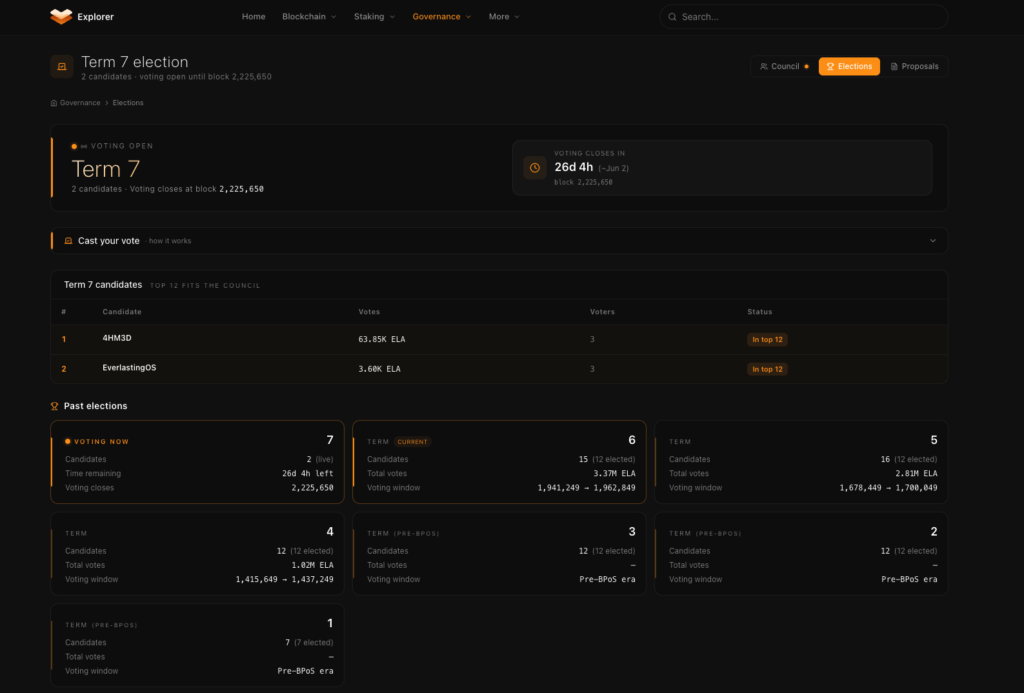
The Term-7 election surfaced several places where the code assumed a tallied past, not a live voting window. Candidates now appear at registration instead of after their first vote, vote totals refresh on every block, chain heights match the canonical half-open intervals, and recurring council members show their active term alongside past ones. Council and Elections each get a focused tab too. /governance is always Council, with a banner linking to Elections page during voting or claim. The half-Elections page that used to appear on Council is gone.
The total supply formula was excluding both burned coins and the DAO Treasury. Only burned coins should be excluded since the treasury is mined and spendable via approved DAO proposals. Visual total supply rises from 23.56M to 26.24M ELA, and total mined from 83% to roughly 93%, while circulating supply and the veto threshold stay unchanged. Roughly eighty findings from the recurring security audit were also closed across container builds, CSV export hardening, reorg recovery, startup races, and a pubkey case-sensitivity bug that could shadow existing registrations.
13. Elacity on the Road: Ecosystem and BD
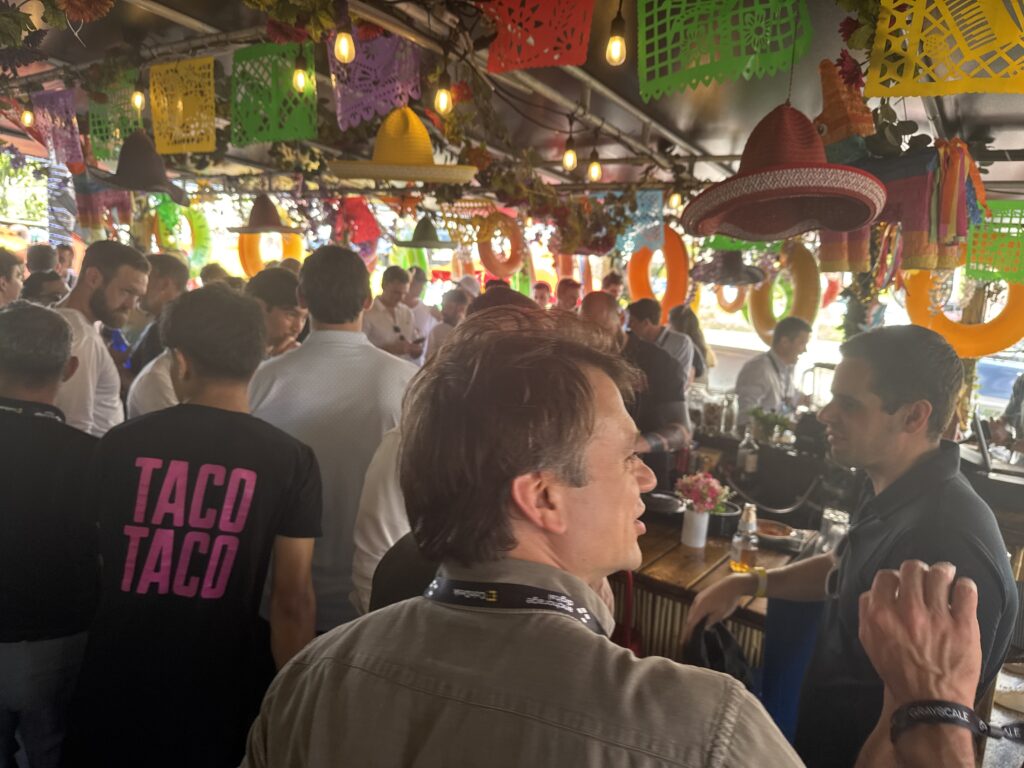
Alongside the development work, Elacity continued its ecosystem and BD push across Bitcoin Week and Miami.
Across 17 events in 11 days, the team tested the Elacity thesis with Bitcoin, tokenization, AI, RWA, institutional, and builder audiences.
The clearest framing was around real-world rights. Securitize tokenizes real-world securities. Elacity is focused on tokenizing real-world rights: royalties, licensing fees, revenue shares, AI training data access, and other IP-linked cashflows.
The message landed because these rights can behave like productive assets. Music royalties, licensing fees, and content revenue streams can produce cashflow that is not directly tied to crypto market cycles.
Across the rooms, the same gap kept appearing:
- Bitcoin audiences saw sovereignty beyond money
- AI builders saw a rights and licensing layer for agents
- Tokenization teams saw the underserved IP and rights category
- Allocators saw a potential new yield-bearing asset class
The next step is follow-up: turning the strongest conversations into partner calls, product feedback, and clearer BD paths for dDRM, Runtime, ACCESS_TOKEN, ERC-8183, and future capsule-based apps.
Summary
This week was mainly a post-v1.2 hardening cycle.
The team focused on installer fixes, updater fixes, launcher status, wallet signing, ESC transaction handling, IPFS fetching, media playback, transport setup, dApp Centre polish, Runtime Home, and dDRM metadata cleanup.
The next focus remains reducing friction across installs, updates, app capsules, dDRM flows, Runtime authority, and media playback.
For the full technical shipping report, read the Elacity PC2 development discussion on GitHub.