ElastOS is moving toward one system built from four parts: the Elastos blockchain, Runtime, Personal Cloud Compute, and Carrier.
The blockchain anchors identity, ownership, settlement, staking, and governance. Runtime is the local authority layer where apps run with permissions instead of open access. PC2 is the personal cloud product users can use today. Carrier is the private network layer that lets nodes, apps, and users communicate without depending on the old cloud model.
The work this week was about connecting those pieces.
No release was tagged this week. The work is sitting on branches and moving toward the end of May release window, around May 29 to 31.
In one breath:
- PC2 was audited against the Runtime capsule contract and found to be 96% one bounded refactor or less from capsule shape.
- Media dDRM moved closer to standard MPEG-DASH CENC behavior.
- A serious dDRM access-control issue was closed with wallet signature recovery.
- v1.3.0 was narrowed into one first slice: Agent Creator Studio.
- Runtime 0.3.0 made Wallet, Browser, and Recovery Kit real authority surfaces.
- Elastos Node Manager now manages the full eight-service Council node stack from one dashboard.
1- PC2 is closer to Runtime than expected
The long-term goal is not to keep PC2 and Runtime as separate worlds.
PC2 is the product people can use today. Runtime is the stricter model underneath, where apps become capsules, permissions are scoped, and wallet access is controlled. For the World Computer to make sense, PC2 has to move toward that Runtime model without breaking what already works.
That is why the first major task this week was direct: check how close PC2 already is to the Runtime capsule contract.
Every TypeScript file in PC2’s node layer was reviewed. The result was better than expected:
- 71% is already A-grade
- 96% is one small refactor away
- Only 9 files need deeper work
- The AI, dDRM, and media systems are already structurally clean
The most important finding was that PC2 already contains pieces of the Runtime contract. It already has permission scopes, middleware that checks those permissions, and provider mappings that connect PC2 functions to Runtime-style operations.
That changes the story. PC2 does not need to be rebuilt from zero. Much of the contract is already there. The next step is cleaning the boundaries, packaging the pieces properly, and moving more of PC2 into the capsule model over time.
A Phase 2 refactor then started removing the biggest blockers: concrete imports, ambient globals, and loose shared state. Several files compiled byte-for-byte the same before and after, which is a good sign that the structure changed without changing how the system behaves.
One useful bug also surfaced: global.db was never set, so some settings reads had been failing silently. That was fixed in the same pass.
2- dDRM moves toward one shared trust path
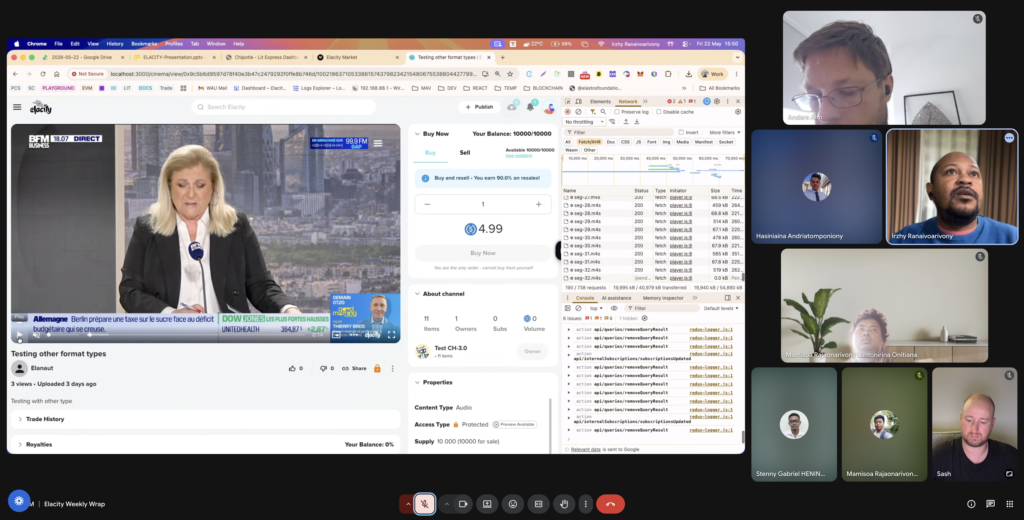
dDRM is one of the places where the four-pillar model matters most.
A creator’s content may be stored and delivered through PC2, accessed through Runtime permissions, checked against on-chain ownership or access rights, and eventually moved through Carrier-based delivery paths. If each layer handles access differently, the system becomes fragile.
This week moved the dDRM stack closer to one shared path.
First, media packaging moved closer to standard MPEG-DASH CENC behavior. PC2 already encrypted media with CENC, but some external tools could not find the key-discovery data inside the file. The fix placed the pssh box where standard tools expect it and stopped removing it from delivery paths where it should remain.
That makes protected media easier to verify outside PC2 while keeping the key path the same.
Second, a serious dDRM access-control issue was closed.
The old path trusted an address sent from the local PC2 client. In a local-first system, that is not enough. A hostile user can edit their own PC2 copy and place another address in the request.
The new path recovers the signer from the wallet signature, derives the related smart-account address, and checks access against both. Access now depends on what the wallet proves, not what the local client says.
The non-media decrypt path also moved onto the same universal Lit Action family used by media, retiring older datil and @elacity-js/access paths.
3- v1.3.0 becomes Agent Creator Studio
A larger plan landed on May 15 around PC2 as a monetisation agent: an AI assistant that helps turn user files into priced, encrypted, tokenized digital assets.
The direction fits the World Computer vision, but it was too broad for one release.
So v1.3.0 was narrowed into one first slice: Agent Creator Studio.
The first version adds a Monetisation Agent mode inside PC2 chat. It helps the user describe what they want to publish, saves that intent, then opens the existing Creator app at the right point. Creator remains the place where minting and wallet signing happen.
That keeps the first version focused. No new minting path. No new wallet path. Less risk to the parts that already work.
4- Runtime 0.3.0 makes authority visible
Runtime is where the personal cloud becomes a safer local system.
The model is now clearer:
- Home is the front door
- Wallet signs and approves
- System handles policy, recovery, and diagnostics
- Browser runs dApps through controlled provider paths
- Normal capsules do not get raw wallet, chain, node, network, IPFS, or host access
Wallet now has built-in EVM and BTC accounts, send and receive flows, QR and address display, account naming, default-wallet selection, MetaMask linking, and a UniSat-style BTC path.
Recovery Kit is becoming the single backup path for recoverable identity and Wallet keys.
Browser now launches through Runtime with one isolated session per open. That removes the old shared-session problem and cleans up shutdown, stale sessions, readiness checks, and heavy processes left behind after failure.
The strongest test was Glide Finance. Its wallet connection and swap flow ran through the Runtime-mediated wallet bridge without exposing raw wallet or chain RPC to the page. ela.city login and signing also works through Browser plus Wallet approval.
This is the bridge between today’s dApps and tomorrow’s capsule model. The dApp still gets the wallet experience it expects, but authority stays inside Runtime.
5- Elastos Node Manager connects governance infrastructure to ElastOS
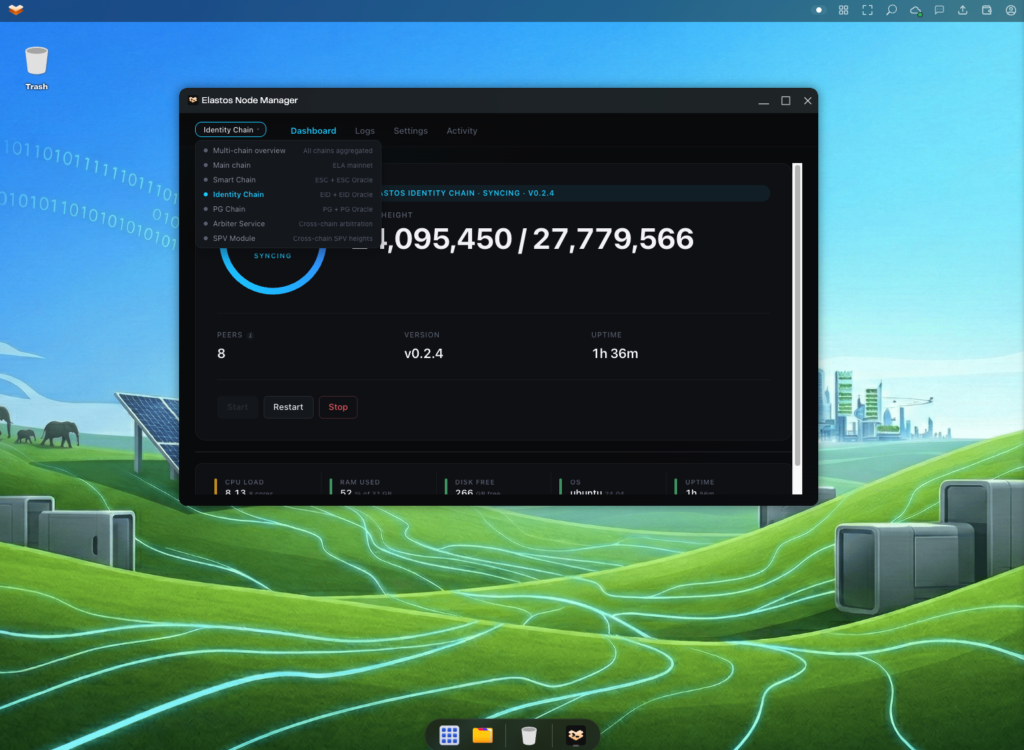
Elastos Node Manager is important because it brings governance infrastructure into the same user-owned environment.
A Council node is not one service. It is eight services running together: main chain, three sidechains, three cross-chain oracles, and the arbiter.
Node Manager brings those into one dashboard.
Operators can see every service, start and stop services, run setup in the correct order, track chain state, view logs, manage peers and bootnodes, and recover from common issues with configurable self-healing.
This matters because the Elastos DAO depends on people running real infrastructure. If Council nodes are hard to manage, fewer people can operate them well. Node Manager lowers that barrier and makes ElastOS useful not only for users and creators, but also for network operators.
The next step is polish, heavy cross-chain testing, and then wider operator testing through PC2.
6- Explorer and Docs Portal fixes
The Main Chain Explorer received two visible fixes.
Dormant wallets now show a flat balance history line instead of an empty chart when they still hold balance. The staking page also recognizes historical and past stakers using the on-chain deposit record, not only current validator votes.
The Docs Portal split user pages from developer pages. Essentials Wallet and PC2 management are now cleaner for normal users, while deeper architecture, CLI, and systemd details sit in developer sections.
A new Council node setup walkthrough also landed under Blockchain Governance. The docs AI chat now works better on phones.
What ships next
The next release window is May 29 to 31.
PC2 v1.2.8.0 is expected first, with one-click support reports, live diagnostics, and telemetry. Apple notarisation of the launcher DMG is complete, so the next Mac release can use a double-click install path without terminal.
Agent Creator Studio is a stretch goal for the same window.
Runtime 0.3.0 continues toward review, with Wallet recovery, account checks, Browser changes, and gateway review still being checked carefully.
After that, the main Runtime gap is macOS bridged networking. dDRM work continues around session signing, module isolation, and player support. Node Manager moves into polish and cross-chain testing before wider release.
Closing
Elastos is not building four separate things. The blockchain, Runtime, PC2, and Carrier are starting to connect into one system: a user-owned computer where identity, apps, content, permissions, networking, and settlement can work together without handing control back to the old cloud model. A capsule is no longer just a design target. This week, the stack started behaving like one.
Full technical write-up with per-commit detail lives in the pc2.net repo.