This was a week of hardening, testing, and expanding the product surface. In seven days, the team shipped lots of new commits, completing the full V3 contract migration (zero V2 addresses remain anywhere), pushing end-to-end tests to 5 out of 7 passing, building a brand-new NFT marketplace app that runs inside the personal computer, starting development on a blockchain explorer, and preparing the Runtime for its v0.1.2 public release.
What Shipped: The Big Picture
Rather than rushing new features, this week was about making everything ready for production. Eight major workstreams were completed:
- ElastOS Runtime, Room Architecture and v0.1.2 Prep, the scattered collaboration room concept was rebuilt as a first-class feature with a cleaner, simpler design
- V3 Contract Migration Complete, every single V2 contract address has been replaced with V3 across every layer of the system
- V3 End-to-End Testing, five out of seven complete transaction flows now pass against the new contracts
- Elastos NFT Marketplace, a new app built from scratch so users can view, buy, sell, and manage NFTs from inside their personal computer
- Market UI Unification, thirteen interface improvements and a full audit of every transaction function
- Blockchain Explorer, a new frontend and backend covering blocks, transactions, validators, staking, and governance
- Infrastructure Improvements, a new public connection point live, supernode cost reductions identified, and macOS installer fix confirmed
- Ecosystem and Community, public statement published, KuMining AMA held, balance monitor bot deployed, and conference media partnerships secured
1. ElastOS Runtime, Room Architecture and v0.1.2 Prep
The ElastOS Runtime is the engine underneath everything, the security guard, traffic controller, and building manager for your digital life. Last week it was released publicly. This week, it was made significantly better.
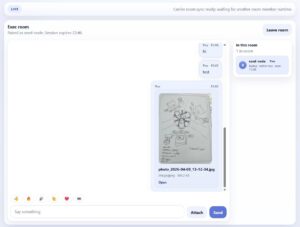
The previously scattered “collaboration room” concept was rebuilt as a proper first-class feature. The idea is elegant: one Room Service inside the Runtime, with the browser, desktop app, command line, and node operator all acting as interchangeable ways to access it. The Room is the product, how you get to it should not matter.
This was tested live with two Runtimes running at the same time. One user sent a join request, another approved it, messages were sent back and forth, and everything synchronised in real time, all verified in a real browser session.
- Public release branch reorganised, the code was cleaned up into a tidy 7-commit stack ready for the v0.1.2 tag
- Reliability improvements, room approval consistency, stale Runtime handling, installer cleanup, and clearer status messages all addressed
- One blocker remains, a smoke test signing mismatch being resolved this coming week before the tag is published
2. dDRM Protocol V3 Contract Migration, Zero V2 Addresses Remain
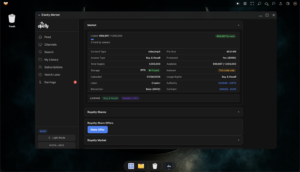
A half-finished upgrade is worse than no upgrade at all. When some parts of the system talk to the old version while other parts talk to the new version, things break silently, transactions fail, data gets lost, and nobody knows why.
This week, the team completed a full-stack migration across every single layer: the central configuration, the server that stores and packages content, the app creators use to publish, the marketplace where buyers shop, the access tools that handle permissions, the content indexer that keeps track of everything, and the infrastructure that runs the network nodes.
- V3 contracts deployed
- Zero V2 addresses remain anywhere in the system, every reference has been updated
- SDK updated to release 0.3.2, reflecting the new contract surface with extra event handling improvements
3. V3 End-to-End Testing
Upgrading contracts means nothing if the apps that use them do not actually work. This week, the team systematically tested every transaction flow against the new V3 contracts. Five out of seven complete end-to-end tests now pass:
- Test 1, Encryption provision: PASS
- Test 2, Channel creation on V3: PASS
- Test 3, Free content minting on V3: PASS
- Test 4, Paid content minting on V3: PASS
- Test 5, Content decryption with V3 authority: PASS
- Test 6, Market shows V3 assets: PASS, the indexer is not yet listing V3 assets
- Test 7, Content indexer V3 config: BLOCKED, final tests
The Creator app received substantial upgrades: V3 support for all three core contracts, automatic channel discovery by scanning on-chain events (replacing the old backend query), faster network calls through parallelisation with local caching, and a royalty bug fix. The V3 system now handles the 5% royalty automatically, so creators no longer need to set it manually.
The wallet connection layer was also hardened: a new network was added to all configuration maps, gas estimation fixed to use the correct identifiers, and an automatic prompt now catches wallet mismatches before transactions fail rather than after.
4. Elastos NFT Marketplace, A New App for Your Personal Computer
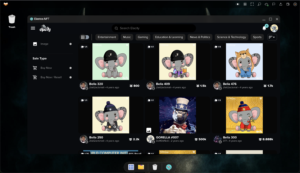
Users who own NFTs on the Elastos network had no way to view, buy, sell, or manage them from inside their personal computer. This week, a dedicated app was built that brings the full NFT marketplace experience into the system.
The existing marketplace web app was adapted to run as a standalone application inside the personal computer. When you open it, your wallet connects automatically, no separate login required. All marketplace data requests route through your own node, keeping the experience private and fast.
- Full marketplace features, browse, buy, sell, and manage NFTs without leaving the personal computer environment
- Reproducible build pipeline, the app can be rebuilt identically by anyone, ensuring transparency
- Technical challenges solved, asset path rewriting for compatibility, handling of special characters in filenames, and automatic network switching on launch
5. Market Interface Improvements and Transaction Audit
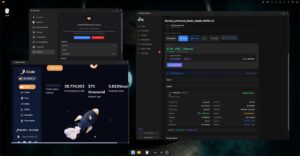
The marketplace interface had accumulated small inconsistencies over time, prices displayed differently in different places, it was not always obvious whether you already owned something, and the controls creators need were scattered across multiple screens. Thirteen improvements were shipped in one pass:
- Prices always visible with a clear ownership badge showing what you already own
- New “owned content” filter, quickly see everything you have purchased
- Publisher controls consolidated, edit price, remove listing, and view earnings all accessible from one detail page
- Display polish, badge alignment, currency labels, and price formatting all cleaned up
Alongside the visual improvements, a comprehensive audit of all 14 transaction functions identified four critical issues where certain wallet types could not cancel listings or offers, plus several lower-priority items including missing loading indicators and no feedback when offers expire. All are documented and scheduled for this coming week.
6. Blockchain Explorer, New Frontend and Backend
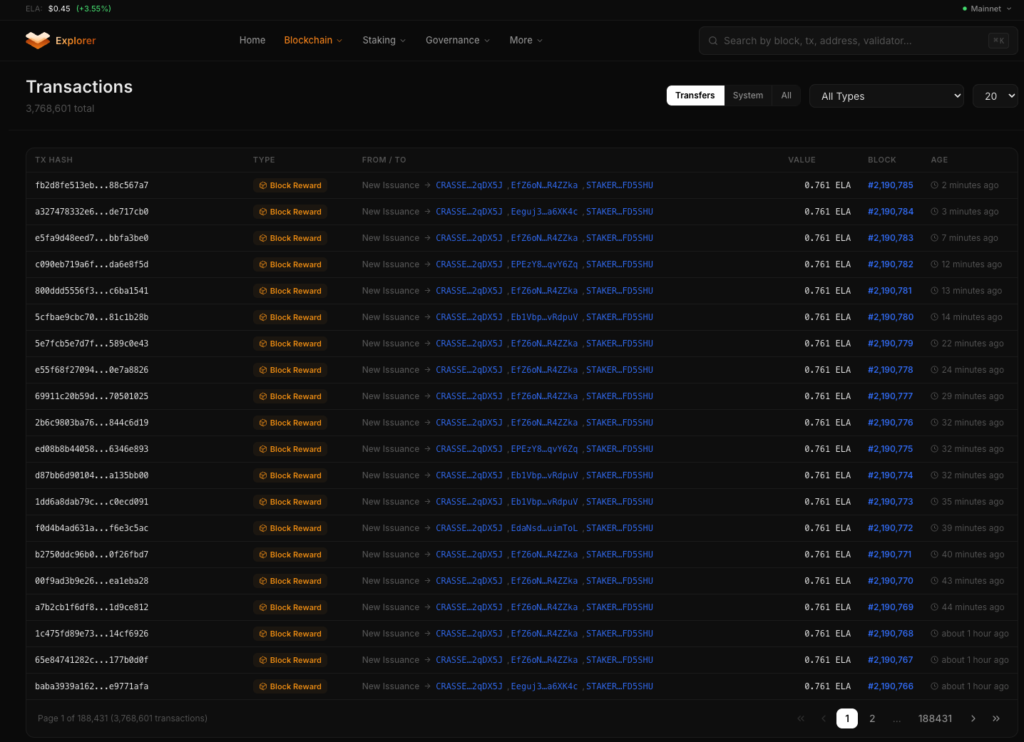
The Elastos community has lacked a modern, comprehensive tool for viewing network activity for the Elastos main chain. People need accessible ways to look up blocks, transactions, validators, staking positions, and governance activity without relying on third-party services that may disappear or restrict access.
This week, both a frontend and a backend were built covering the full data surface:
- Blocks and transactions, browse recent activity and look up specific entries
- Validators and staking, view who is securing the network and staking rankings
- Governance, see live or past Council members and all proposals
- Rich list and mempool, view top holders and pending transactions
- API Documentations, use main chain data anywhere
- Per address metrics, like Balance history, Staking and Governance activities
In traditional professional terms, this scope of work, a full explorer with database backend, API layer, and interactive frontend, is often a five- to six-figure build. The foundation is in place and will be deployed as a public-facing tool in the coming weeks.
7. Infrastructure and Operations
A new public connection point for the Elastos main chain is now live, giving developers and applications a reliable way to interact with the network. Supernode benchmarks revealed that current server specifications are significantly more powerful than needed, with potential cost reductions from roughly $115 per month per node down to $45–60, which would make running network nodes more accessible to community operators.
- Both supernodes live with production encryption configuration and full chain synchronisation verified
- macOS installer fix confirmed, Apple’s developer support team confirmed the workaround previously attempted was unnecessary, and a straightforward resubmission will complete the Mac installer
- Events publication pipeline 90% complete, the fix for event scope was submitted, with all handler methods implemented
8. Ecosystem and Community
- KuMining AMA held April 9th, engaging with the mining community about ELA merge-mining on KuCoin’s platform
- Three creators briefed as ambassadors with next goals and updates
- Media partner introduction for Bitcoin 2026 Las Vegas and Google Next
- Easter holiday and weekly update banners created and distributed
Website and Portal Updates
portal.ela.city
- New weekly development report added with full detailed breakdown
- Monthly delivery summary updated, April now includes both weeks with cumulative totals
- Two new transactions added with full expense breakdowns and receipt documentation
- Transaction loading improved with pagination and lazy-loaded details for faster performance
V3 Protocol
- SDK 0.3.2 released with improved event handling
- Smart contract events deployed on both testnet and mainnet
- Events publication pipeline nearing completion
What’s Next
- Runtime v0.1.2 release, resolve the smoke test signer mismatch, tag and publish the next public version
- Market critical fixes, fix the four critical transaction issues identified in this week’s audit
- V3 frontend wiring, connect the new SDK to the marketplace interface
- Content indexer V3 migration, unblock the final two end-to-end tests
- Explorer deployment, polish and publish the blockchain explorer as a public tool
- NFT marketplace testing, full end-to-end testing of all marketplace features inside the personal computer
- macOS installer resubmission, standard format resubmission to complete the Mac installer
- Supernode-native encryption relay, research replacing the current key service with a supernode solution
- Conference circuit begins, Google Cloud Next (Apr 22–24), Bitcoin 2026 (Apr 27–29), Consensus Miami (May 5–7), DAT Summit (May 8), FT Digital Assets Summit (May 13–14)
Try ElastOS
- Desktop Launcher (Mac and Linux): Download Launcher
- Terminal Install (Mac/Linux): curl -fsSL https://raw.githubusercontent.com/Elacity/pc2.net/main/scripts/start-local.sh | bash
- Runtime Install: curl -fsSL https://raw.githubusercontent.com/nicosql/elastos-runtime/main/scripts/install.sh | bash
- NVIDIA Jetson: cd ~ && git clone https://github.com/Elacity/pc2.net.git && cd pc2.net && sudo bash scripts/install-arm.sh
- Docs: docs.elastos.net | GitHub: github.com/Elacity/pc2.net
- Network Map: map.ela.city | Portal: portal.ela.city
- DAO Proposal: Keystone Fund Mandate
- Shipping Report: GitHub Discussion #10